Onda Bay Harbor Versus Origin Bay Harbor Islands: Evaluating Smart Home Integrations on the Water
Quick Summary
- Onda Bay Harbor leans into integrated control and marina-adjacent living
- Origin Bay Harbor Islands emphasizes customization, privacy, and AI-led comfort
- Both position smart systems as included luxury, not an obvious add-on
- Buyers should press for written clarity on compatibility, security, and support
The new luxury question in Bay Harbor
In Bay Harbor, the conversation around waterfront luxury has shifted. Finish quality, privacy, and boating access still matter, but sophisticated buyers increasingly ask a more technical question: how intelligently does a residence actually operate once the doors close? In that respect, Onda Bay Harbor and Origin Bay Harbor Islands stand out because both make smart-home integration central to their residential identity.
The distinction is worth examining carefully. Both projects present connected living as part of the baseline experience, not as a visibly itemized upgrade. Onda Bay Harbor frames technology as an extension of waterfront convenience, blending in-residence controls with broader building systems and a marine-adjacent lifestyle. Origin Bay Harbor Islands, by contrast, presents automation in a more personalized register, with attention to comfort, entertainment, privacy, and configurable levels of control.
That difference may sound subtle in marketing language, but in daily use it can shape everything from climate response to visitor access to the long-term logic of ownership.
Onda Bay Harbor: integrated systems with a waterfront sensibility
Onda Bay Harbor is positioned as a smart-home-focused waterfront development in Miami-Dade County, with residences designed around app- and voice-accessible control of climate, lighting, and security. The appeal is not simply novelty. It is the idea of a residence that functions as a coherent digital environment, where multiple systems are intended to work in concert rather than as a patchwork of premium gadgets.
Disclosed details also suggest broader building-level intelligence behind the private residence. Onda has been described with centralized management tied to systems such as HVAC, water management, and energy monitoring, supported by fiber-optic-enabled infrastructure for high-bandwidth digital use. For a buyer, that matters because the most successful smart homes are rarely defined by a single interface. They are defined by the quality of the underlying backbone.
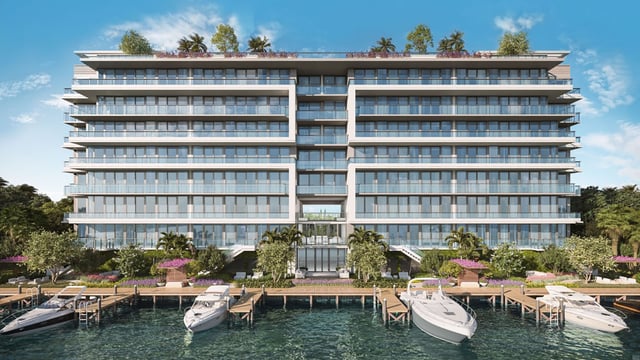
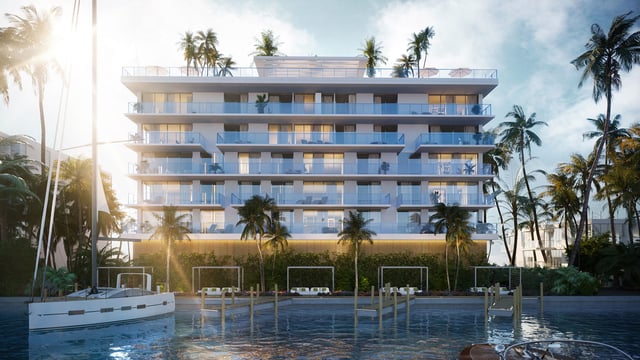
Security is another key part of Onda Bay Harbor’s proposition. Smart access control, video surveillance, and emergency-response connectivity tied to on-site operations suggest a more operational definition of luxury, one in which convenience and oversight are designed to coexist discreetly. In a waterfront setting, Onda also places unusual emphasis on marine-oriented convenience, including technology linked to yacht monitoring, dock-related automation, and the rhythms of boat-slip ownership. That makes its tech story feel especially aligned with the preferences of buyers comparing it with other boutique Bay Harbor addresses such as La Maré Bay Harbor Islands.
Origin Bay Harbor Islands: tailored automation with a privacy-first tone
Origin Bay Harbor Islands is presented as an ultra-luxury development where home automation is a principal selling point. Its language is less about centralized systems as an operational framework and more about the tailored experience inside the residence itself. Voice-activated controls, intelligent lighting, integrated entertainment, and personalized climate management all point to a more individualized automation profile.
One of Origin’s more notable distinctions is its emphasis on customizable smart-home packages with tiered levels of automation for different buyer preferences. For owners who do not want a one-size-fits-all interface, that is meaningful. Some buyers want invisible automation that handles temperature, lighting scenes, and security in the background. Others want a more expressive platform that also extends to media, entertainment, and routine-based personalization. Origin Bay Harbor Islands appears to court that latter buyer more directly.
Privacy and digital security also sit closer to the center of Origin’s positioning. Its connected-home narrative highlights advanced access systems and protected digital environments, while also leaning into AI-driven comfort and energy optimization. The promise, in essence, is that luxury should feel anticipatory without becoming intrusive. That idea places Origin comfortably within a broader conversation across contemporary South Florida development, including design-led projects such as The Well Bay Harbor Islands.
Where the smart-home difference is most meaningful
For the buyer deciding between Onda Bay Harbor and Origin Bay Harbor Islands, the comparison becomes clearer when reduced to use cases rather than slogans.
If your lifestyle is deeply tied to the water, Onda Bay Harbor has the more distinctive narrative. Its technology package appears to extend beyond the residence and into the lived logistics of waterfront ownership. That may resonate with buyers who value integrated oversight across access, building systems, and marine-adjacent routines. In that sense, Onda Bay Harbor feels like a property where technology is meant to support movement between home, dock, and shared operations with minimal friction.
If your priority is curating the atmosphere inside the home, Origin Bay Harbor Islands may read as the more nuanced fit. Its emphasis on customizable automation, intelligent lighting, integrated entertainment, and AI-led climate response suggests a residence shaped around personal habits. That makes it compelling for owners who think of luxury less as system architecture and more as precise environmental control.
The distinction also matters for resale psychology. In boutique developments across Bay Harbor, purchasers increasingly expect some degree of built-in digital living, much as they expect refined kitchens or private outdoor space. Comparable projects such as Bay Harbor Towers reinforce how the neighborhood continues to value polished, modern residential experiences. But when two projects both promise smart-home integration, the differentiator becomes less whether the technology exists and more how elegantly it has been conceived.
The questions sophisticated buyers should ask now
There is, however, an important note of discipline. While both developments present smart systems as part of the included residential offering, full technical detail on standards, protocol compatibility, certifications, measured energy performance, and long-term interoperability has not been comprehensively disclosed in public-facing materials. For a primary residence, this may be a manageable due-diligence exercise. For a second-home owner, it is essential.
A serious buyer should request written confirmation on several fronts: what platform or platforms anchor the home, what third-party devices are supported, whether remote diagnostics are available, how cybersecurity is handled, what resident support is included, and what upgrade path exists as hardware ages. This is particularly important in new-construction product, where the finish may be timeless but the technology layer will inevitably evolve.
Concierge-style technical support is part of the appeal at both projects, and that can be genuinely valuable, especially for buyers who split time between markets. Still, service responsiveness, replacement cycles, and software continuity deserve the same scrutiny as building maintenance planning. Smart luxury is only as persuasive as the consistency with which it performs.
The verdict
Onda Bay Harbor and Origin Bay Harbor Islands are not offering identical visions of connected waterfront living, even if their brochures occasionally speak in similar tones. Onda Bay Harbor appears strongest when smart integration is understood as infrastructure, operational coherence, and waterfront utility. Origin Bay Harbor Islands is strongest when smart luxury is understood as personalization, privacy, and an interior environment that responds with greater nuance.
For some buyers, that makes the choice simple. If the residence is a launch point for a boating-centric lifestyle, Onda Bay Harbor may feel more aligned. If the residence is a highly calibrated private retreat, Origin Bay Harbor Islands may offer the more compelling proposition. In either case, Bay Harbor continues to mature as a boutique enclave where technology is no longer decorative. It is part of the architecture of luxury itself.
FAQs
-
Which project places more emphasis on waterfront-specific smart features? Onda Bay Harbor appears to do so, particularly through its emphasis on marine access, yacht monitoring, and dock-related automation.
-
Which development seems more customizable for in-home automation? Origin Bay Harbor Islands is presented as offering tiered and customizable smart-home packages for different buyer preferences.
-
Are smart-home features treated as upgrades or included amenities? Both projects position smart-home integration as part of the standard luxury offering.
-
Does Onda Bay Harbor focus on building-wide systems as well as in-residence controls? Yes. Its positioning includes centralized management tied to systems such as HVAC, water management, and energy monitoring.
-
Does Origin Bay Harbor Islands emphasize privacy in its technology story? Yes. Privacy, advanced access systems, and protected digital environments are central to its connected-home positioning.
-
Which project may suit a buyer with a boat-slip lifestyle better? Onda Bay Harbor may be the more natural fit for owners whose routines revolve around waterfront access and marina-adjacent convenience.
-
Is AI part of the comparison? Origin Bay Harbor Islands places more visible emphasis on AI-driven comfort and energy optimization.
-
Are detailed technical specifications publicly comprehensive for either project? No. Buyers should still request written details on compatibility, cybersecurity, support terms, and future upgrade options.
-
Is this comparison most relevant to pre-construction buyers? Yes. Pre-construction purchasers benefit most from clarifying exactly what technology is delivered at closing and how it can evolve.
-
Why does this matter in Bay Harbor’s luxury market? Because smart-home execution increasingly shapes convenience, privacy, resale appeal, and the day-to-day ownership experience.
For a tailored shortlist and next-step guidance, connect with MILLION Luxury.

Million Luxury
Million Luxury
Welcome to MILLION, an exclusive luxury real estate boutique nestled in the heart of South Florida’s most desirable locations. Specializing in high-end properties, we provide a sanctuary for discerning clients including top Fortune 500 executives, affluent families, celebrities, and professional athletes from across the globe. At MILLION, we understand the unique demands of our elite clientele and offer a seamless blend of confidentiality and personalized attention. Our commitment to privacy is unwavering; we ensure that every transaction and interaction is handled with the utmost discretion and according to stringent confidentiality protocols. Our concierge service embodies the pinnacle of white-glove care, offering tailored assistance that transcends traditional real estate support.